
Journal of Biological Chemistry
The AI answer showed its sources. Are those really all the papers?
Readment keeps looking for the papers you have not found yet and gathers the paragraphs that answer your question.
Every answer comes with its source paragraph, so you can read the original and judge for yourself.










Answers with sources
are available everywhere now.
But you cannot tell about the papers missing from the answer. Were they left out because they are irrelevant, or because they were not found?
So sometimes you want to check the papers the AI answer left out.
Paragraphs that answer your question,
gathered in their original words.
Same RNA-seq data, different results. Which genes should we validate?

Select a citation in the answer
to go to the original text.
 Research partner
Same RNA-seq data, different results. Which genes should we validate?
Prioritize genes with a consistent direction and meaningful effect size that do not depend on a single sample, rather than selecting only the intersection of two tools. This is a proposed validation strategy based on the papers below. With three biological replicates per group, gene-wise variability estimates can be uncertain.
First confirm that the analyses test the same treatment-versus-control contrast using the same count data and gene definitions. Check how batches and covariates enter the model. limma supports explicit contrasts and batch adjustment, and sample-level plots can reveal unexpected structure.
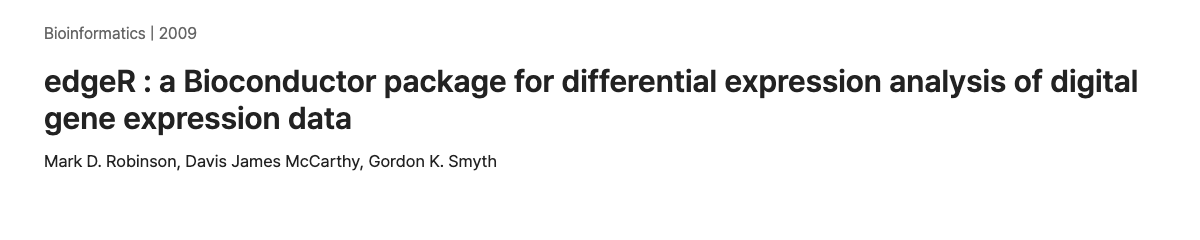
The methods handle uncertainty differently. DESeq2 uses size factors and shares information across genes when estimating dispersion. The TMM normalization paper explains how RNA composition can bias comparisons based only on total read counts. limma-voom estimates the mean-variance relationship of log counts and converts it into precision weights. Different significance calls do not, by themselves, establish that one tool is wrong.
Inspect discordant genes for low counts, variable replicates and influential observations. DESeq2 describes stronger fold-change shrinkage when information is limited and warns that a single extreme observation can influence both effect size and P values. Removing inconvenient observations from a small experiment is not a sound solution.
Separate statistical significance from biological importance. Adjusted P values address multiple testing; a large or meaningful effect is a different question. DESeq2 discusses directly testing an effect-size threshold instead of adding a fold-change filter after testing against zero.
As a practical proposal, prioritize genes with consistent direction, reproducible sample-level patterns and a meaningful connection to the hypothesis. Investigate genes significant in only one tool before discarding them. Defer genes with reversed direction or dependence on one observation until the source of disagreement is understood.
These papers do not establish that one tool is always superior or that three replicates are sufficient. Actual candidates require the count matrix and sample metadata. The papers describe methodological principles; check the versions and settings used in the current analysis.
Original sources for this answerMichael I. Love et al. Mark D. Robinson et al. Matthew E. Ritchie et al.
01 / 06
Start with what you want to know.
AI RESEARCH WORKSPACE
Connect papers, notes, evidence and conversations
in one research workflow.
Your papers, organized by research topic.
Take the surveys.
Get 500 credits.
Readment is in beta. Share your view as a researcher and receive credits for about 5 questions.
- Step 1Sign up and answer the first survey200 creditsAbout 2 questions
- Step 2Use it, then answer the follow-up survey+300 creditsAbout 3 questions